
The Real Opportunity Behind the Media Spectacle
Historic U.S.-Russian meetings tend to occur outside of Washington and Moscow. Franklin Delano Roosevelt first encountered Joseph Stalin in Tehran. At the end of World War II, they met again at Yalta, a name that would thereafter signify Soviet domination of Eastern Europe. Harry Truman’s one and only meeting with Stalin was in Potsdam, a suburb of Berlin. John F. Kennedy had a shaky meeting with Nikita Khrushchev in Geneva, while Ronald Reagan had a memorable collision with Mikhail Gorbachev in Reykjavik.
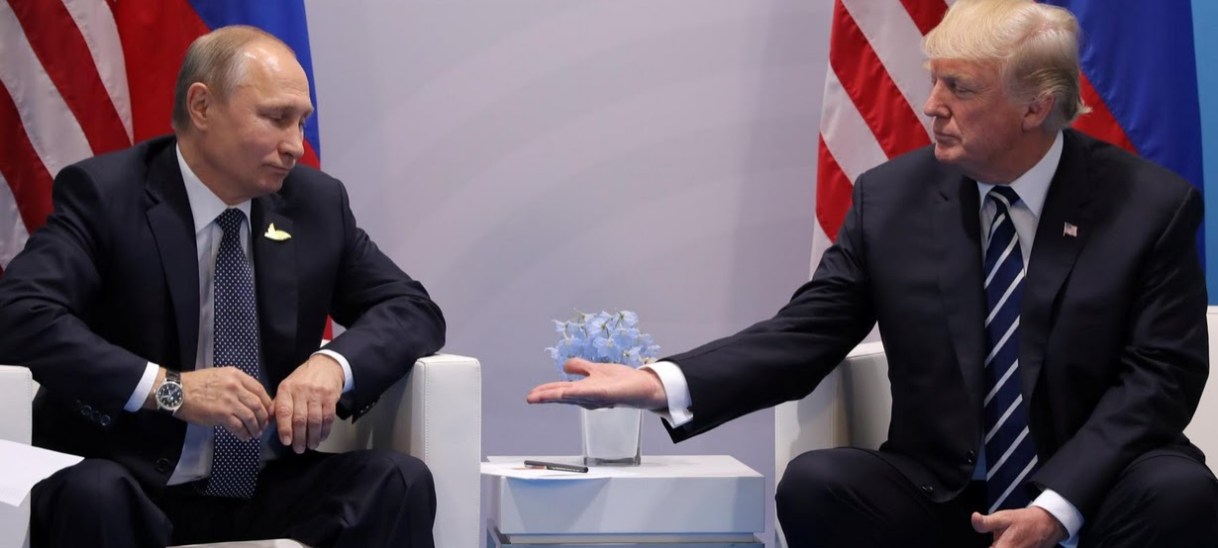
U.S. President Donald Trump and Russian President Vladimir Putin will meet for a frenetically anticipated summit on July 16 in Helsinki. Their encounter—coming amid cascading revelations of Russian interference in the 2016 presidential election, unnerving questions about Trump’s admiration for his Russian counterpart, and U.S.-Russian tensions around the globe—is certain to be a media spectacle. But as its location subtly implies, the real importance of the meeting may have little to do with the theatrics at the top. Unglamorous, largely unnoticed diplomatic processes could prove more consequential. In Helsinki in 1975, the United States, the Soviet Union, and various European powers devised a security architecture for Europe that was controversial at the time but ultimately crucial to the Cold War’s peaceful end. Without the Helsinki Accords, which fostered agreement on Europe’s borders and enshrined a nominal commitment to human rights in the Eastern bloc, the revolutions of 1989 may never have come and almost certainly would not have been as peaceful as they were.
The lessons of that previous U.S.-Russian encounter in Helsinki are worth remembering now. The agreement that resulted involved years of drab, painstaking diplomacy. It required agonizing compromise on both sides. It rested on work rather than optics. Under the shadow of low expectations, a difficult process preceded final success. The summit’s real importance, in other words, had little to do with momentary media spectacle. The same could be true of next week’s Trump-Putin meeting. No matter the sensational headlines in the summit’s immediate aftermath, a quiet yet substantive diplomatic process has the potential to yield real, and welcome, results.
THE RIGHT KIND OF SUMMIT
At a rally last week, Trump dismissed concerns about his meeting with the Russian president, saying, “Putin’s fine.” This generated a ripple of headlines. Russian television, meanwhile, is awash in speculation about Putin’s potential achievements in Helsinki. American observers rightly fear the impact of stray words from Trump and potential strategic missteps that could flow from the very melodrama of the event itself. To many, the optics are the story, and the optics can only be wrong: Putin standing shoulder to shoulder with an American president under investigation for subversive ties to Russia, uncertain about the NATO alliance, and enamored of the deals or pseudo-deals that emerge from a welter of exaggerated expectations.
An age of social media is prone to framing politics in cinematic terms. A troubled meme waiting to happen, the Trump-Putin summit wonderfully suits the age. The problem, however, is not a meeting as such but the real possibility of holding the wrong meeting. A summit that involves up-front U.S. concessions for the sake of some ill-defined triumph would be worse than a missed opportunity.
Consider the last high-profile U.S. summit with North Korea. Trump clearly oversold his June meeting with North Korean leader Kim Jong Un. What was billed as the chance to ratify denuclearization for the entire Korean Peninsula ended up being a noncommittal meeting between two heads of state. North Korean conduct since the summit shows that it is undeterred. In time, the personal relationship between Kim and Trump may prove an asset, but only a long, detailed process of negotiation and verification can ensure that North Korea has given up its nuclear weapons. The summit in Singapore was merely the beginning of the journey.
So, too, will the Trump-Putin meeting be a beginning. It cannot guarantee much in and of itself. Over the past few years, the United States and Russia have let their diplomatic relationship erode. A Russian-U.S. presidential summit has not been held for the past eight years. One would have to scrutinize the annals of Cold War history to find a period when there has been so little diplomatic contact. The list of differences and grievances on both sides is endless, as the U.S. Congress will remind the president should he offer Russia anything that touches either on sanctions or on U.S. treaty commitments.
This is why the history behind Helsinki could be a road map for the Trump administration. Trump’s meeting with Putin should be used to create a framework for diplomatic engagement and for process. U.S.-Russian working groups should be embedded in the State Department and the Pentagon, along with bipartisan working groups in the U.S. Congress. Other working groups to the side of government should be encouraged and given the U.S. government’s material support.
Ukraine and Syria are the two most urgent problem sets. On the former, diplomacy has stalled. France, the United Kingdom, and the United States appear to be consumed with other problems. Talks with Russia on the core issues behind the Minsk agreements—a cease-fire, a restoration of Ukrainian sovereignty, a workable political order in the Donbas region of eEastern Ukraine—might stimulate the Western appetite for leadership. With the rebels surrendering, President Bashar al-Assad’s Syria will be taking on a new form, the volatility of which could provoke a war between Iran and Israel. This is an outcome Russia and the United States would both want to avoid. They should be looking ahead in consultation with each other. U.S. leverage over Israel and Russian leverage over Iran is incomplete, but a basic degree of coordination would certainly help prevent conflict. Addressing these dilemmas should not be deferred to 2020 or 2024. Arms control, counterterrorism, the Arctic, and space are other issues that deserve real bilateral attention. Low-key discussions out of the public eye have modest potential, and the Russian and U.S. presidents could give these discussions a preliminary blessing in Helsinki.
In an ideal world, Trump would raise the issue of election interference one-on-one with Putin. Those U.S. officials who join Trump at other meetings would do the same. No less important, Trump would make an emphatic public statement about Russian meddling while together with Putin, as French President Emmanuel Macron has done at comparable moments. Putin will deny the meddling, and Trump should neither accept this denial, as he has in the past, nor make an official acknowledgment from Putin a precondition for moving forward. The confession will never come, but raising the issue with clarity and without embarrassment would convey American resolve and a willingness to respond. If Trump waffles on the issue in Helsinki, however, Russia will score a propaganda victory and will likely be emboldened to test further what redline, if any, the administration has on meddling.
BORING IS BETTER
Trump has a proverbial attachment to hype. But his administration should do what it can to undersell the summit with Putin and avoid painting it as a breakthrough before or after. Instead, it should pay tribute to the years of irritating and boring diplomacy that generated the Helsinki Accords. Internally, the administration should prepare for the follow-up to the summit—the gradual normalization of diplomatic ties between the two powers whose relationship is integral to the future of Europe and the Middle East. A nonrelationship with Russia is simply not in the U.S. national interest.
Continued pressure where interests diverge plus diplomatic normalization would be a new approach for the United States. If it fails, the pressure can always be increased. Progress, if achieved, would be incremental.
Once the summit is over, the president will likely shift his attention elsewhere, as he seems to have done after his meeting with Kim. A trade war with China and the U.S. congressional midterm elections may be more engrossing than election modalities in the Donbas or the dynamics of regional competition in Syria. Handing off the job of negotiating with Moscow to Secretary of State Mike Pompeo, Secretary of Defense James Mattis, and National Security Adviser John Bolton would be the logical next step. These are all Russia hawks who could exploit the face-saving potential for Putin of Trump’s rhetorical friendliness toward Russia and of Trump’s relative popularity in Russia while working toward normalizing relations. Pompeo, Mattis, and Bolton would not sell out Europe for an elusive quid pro quo in Syria; but they could be tasked to reverse the downward spiral of the U.S.-Russian relationship. This in turn could open up new options in Ukraine and Syria, options the United States might be happy to have.
To succeed, though, this approach would have to employ the self-discipline, patience, and attention to detail demonstrated nearly 45 years ago in the austere Scandinavian city of Helsinki.
 Jonathan Maza