Omar García Harfuch and the relaunch of security as a priority for the Mexican State: From moral discourse to institutional effectiveness

The first year of Claudia Sheinbaum’s government marks a turning point in public security and national security policy: Mexico is transitioning from rhetoric to results, from ideology to intelligence.

The appearance of Security Secretary Omar García Harfuch before the Senate of the Republic was not just an exercise in accountability, but an act of political affirmation: the Mexican State is recovering its capacity to govern the territory and control violence. For some, the speech marked a silent break with the recent past; for others, it is something closer to change without rupture. Where there were once moral promises, today data, results, and structures are presented to demonstrate that security, for the first time in a long while, is explained through effectiveness.

Toward the Second floor of the Transformation in security matters: The state recovers ground

In the analysis of Secretary García Harfuch’s speech during his appearance before the Senate, it is clear that his political intention is to show that Mexico is entering a new stage of the Fourth Transformation: one where security is no longer defined by narrative, but by the State’s capacity to produce measurable and sustainable results.

Beyond the numbers—which were many and compelling—the political message was another: the institutional reconstruction of public security as the backbone of Claudia Sheinbaum’s government. That is why what we heard was not a simple speech to applaud achievements, but a roadmap toward a more ambitious project: a modern, technologized, and intelligence-based State Security, which will have costs in terms of both resources and a new social pact regarding citizens’ freedoms.

From this argument arise the recent constitutional and legal reforms in security matters that have been legislated in the last year, subject to criticism from various actors who have considered them contrary to citizens’ freedoms and the progressivity of human rights.

During the past six years, security in Mexico was explained through a moral narrative: «the good against the corrupt,» «hugs instead of bullets.» That narrative had its historical moment to help implement a new regime, but it also had its limits.

Today, under Claudia Sheinbaum’s administration, the strategy seems to have shifted to different ground: institutional efficiency, federal-territorial coordination, and police professionalization to provide support for the second stage of the Fourth Transformation (4T) political project, of which President Sheinbaum is a part, moreover as its first president emerging from that political movement without origins in the old regime.

In a Senate with an official majority and a testimonial opposition, Secretary Harfuch presented figures that speak of a country that, despite its wounds, is beginning to recover operational capacity and institutional trust. The 46% decrease in crime-related homicides compared to 2018, the dismantling of more than 1,500 methamphetamine laboratories, and the capture of more than 35,000 violence generators are data that by themselves send an unequivocal message: the State is returning to exercise control over the territory.

But it is not just about numbers; it is about a reconstruction of the Mexican State from its most sensitive architecture: security.

The new map of security in Mexico

The states and regions mentioned in the speech—Guanajuato, Jalisco, Nuevo León, Guerrero, Tabasco, Tamaulipas, and the northern border—were not chosen at random. They are, at the same time, the country’s industrial nodes and the main corridors of organized crime.

The message is clear: security and economic development are no longer separate issues. In a context of nearshoring, energy investment, and industrial relocation, the federal government’s priority is to protect critical infrastructure and supply chains, especially in the center and north of the country.

The deployment of 10,000 National Guard elements in seven border entities and the record seizures of cocaine, weapons, and fentanyl not only reflect operational efficiency: they reaffirm the political will to build, from the Mexican side of the border, a wall of sovereignty based on intelligence and actions with strategic impact, not just rhetoric, especially in a context of enormous pressure from the United States under the Trump administration.

Cooperate without subordinating

An aspect little commented on, but of enormous strategic relevance, is the new relationship with the United States. The transfer of 55 high-profile criminals to U.S. prisons is a calculated gesture: it shows willingness to cooperate, but also sovereign decision-making capacity, albeit aware of the existing asymmetrical relationship.

Harfuch has achieved what few officials in recent administrations have: being a reliable interlocutor for Washington without renouncing the nationalist narrative that characterizes the 4T. That skill, forged in his career as a police officer and as a politician, makes him today one of the most influential actors with the greatest projection toward 2030.

Peace as a public good of the State

Perhaps the most important message of the speech was not said with words, but with structure: every achievement, every figure, every operation was presented as a result of inter-institutional coordination between the Army, Air Force, Navy, National Guard, and state governments.

That way of presenting the results conveys a central idea: security does not depend on one person, but on a system. A system that, with its imperfections, is beginning to function with its own logic.

The concept of lasting peace appears not as an ethical promise, but as a measurable institutional goal: criminal intelligence, territorial presence, and verifiable reduction of crimes.

In summary, it is about governing the territory again from the State’s public policy, and not from reaction or improvisation.

A new political cycle

President Sheinbaum knows that security will be the thermometer of her six-year term. In view of the 2027 midterm election that will renew the Chamber of Deputies and the eventual mandate revocation referendum, advances in this area could define the political direction of her government and the legacy of which she is a part.

That is why Harfuch’s speech before the Senate, more than a simple appearance, should also be read as an internal political message: the security cabinet has direction, method, and results. In an administration that seeks to consolidate its own stamp within the Fourth Transformation, security has become the bridge between political legitimacy and technical effectiveness.

Mexico seems to be leaving behind the stage of narratives to enter that of results; therefore, the challenge now will be to sustain those results over time, ensuring they do not depend on names or circumstances, but on solid, reliable, and permanent institutions.

Security is not a goal: it is a continuous process of learning and adaptation, and perhaps for the first time in a long while, the Mexican State is beginning to show that it has learned to learn.

Harfuch’s speech was not the closure of a cycle, but the beginning of a new one: that of a country that, with all its contradictions, is once again believing that it can govern its destiny through intelligence, law, coordination, and cooperation.
Analysis of the New Security Strategy of the Government of Mexico: Challenges and Perspectives

Por Jonathan Maza

On October 8, 2024, President Claudia Sheinbaum Pardo’s government presented its new Security Strategy, a plan aimed at confronting the growing violence and organized crime in Mexico. This strategy intends to continue the efforts of her predecessor, Andrés Manuel López Obrador, but with a renewed focus that emphasizes the centralization of coordination and cooperation between security forces and the pursuit of solutions to the social and economic causes of crime.

Objectives and Pillars of the Strategy

The main objective of the new strategy is to reduce high-impact crimes such as homicides, kidnappings, and extortions linked to organized crime. Citizen security, especially in high-risk areas, will be a priority. The need to strengthen the National Guard is emphasized, while also promoting a more integrated approach to addressing the roots of crime.

The strategy is based on three key objectives and four pillars:

  1. Decrease High-Impact Crimes: Violence linked to organized crime, such as homicides and kidnappings, is the primary target. Special attention will also be paid to crimes like extortion and highway robbery.
  2. Neutralize Violence Generators: This involves focusing on criminal networks and the main actors responsible for violence in each of the 32 states. High-crime areas will be the focus of more intensive security operations.
  3. Strengthen Local Prevention: Prevention will be key in the fight against crime, with an emphasis on strengthening the capabilities of local police to improve proximity to the community.
  4. Address the Social and Economic Causes of Crime: Social programs like «Youth Building the Future» will continue, and efforts will be made to involve all sectors of government to create viable alternatives for young people at risk of joining criminal groups.
Consolidation of the National Guard and Armed Forces

One of the most significant measures in this strategy is the transfer of the National Guard (GN) to the control of the Secretariat of National Defense (SEDENA), which will consolidate the military presence in public security. This move has generated controversy due to concerns from certain sectors about the militarization of security functions, which could lead to greater use of force and an increase in confrontations with criminal organizations.

However, the National Guard has also taken on criminal investigation functions as an auxiliary to the Federal Attorney General’s Office (FGR), and significant efforts are being made to professionalize and train its personnel to act more efficiently and professionally.

Strengthening Intelligence and Interinstitutional Coordination

The success of this strategy will largely depend on the government’s ability to coordinate its efforts at various levels. The creation of the National Intelligence System and the strengthening of the capabilities of the National Intelligence Center (CNI) are crucial steps to integrate information from various security agencies, such as the Ministry of Defense (SEDENA), the Navy (SEMAR), the SSPC, the FGR, and state prosecutors.

One of the key aspects of this approach is coordination between federal and state security forces, which will enable a more effective response to the challenges posed by organized crime, especially in regions like the northern border, which faces specific challenges due to violence and drug trafficking.

Challenges and Criticisms of the Strategy

Despite the good intentions, the new strategy faces several structural and operational challenges. First, the operational dependence on military capacities for public security raises concerns about the effectiveness of results in building a public security environment and the potential violation of human rights, a recurring issue during López Obrador’s administration. The growing role of the Armed Forces, both in controlling the National Guard and executing security operations, could lead to greater confrontation with criminal groups, increasing violence and collateral damage in areas already affected by crime.

Another concern is the inefficiency of social programs. Despite efforts to offer alternatives to vulnerable young people, the economic incentives from social programs have not significantly reduced crime rates. There is a risk that criminal organizations and their families may exploit these resources, perpetuating the cycle of violence rather than breaking it.

Furthermore, the restructuring of security and intelligence institutions could lead to coordination problems between various agencies, potentially affecting the flow of information and overall efficiency.

Impact on the Northern Border

One of the most affected states will be Baja California, which, in 2024, recorded one of the highest rates of intentional homicides in Mexico. Territorial disputes between cartels such as the Sinaloa Cartel and the Jalisco New Generation Cartel are the primary causes of this violence. While the region has received a historic investment of 280.4 million pesos for public security, the conditions along the Baja California-Sonora border remain complex, especially in areas like the Mexicali Valley, where violence persists.

The strategy should focus on strengthening coordination between federal and local authorities, especially in high-risk areas, to improve effectiveness in the fight against organized crime.

Conclusion

The new Security Strategy of the Government of Mexico has the potential to be a positive step toward reducing violence in the country, but it depends on its correct implementation and the government’s ability to overcome the many challenges it faces. The operational dependence on the Armed Forces, the inefficiency of social programs, and interinstitutional coordination are just some of the obstacles that could limit its success.

As President Sheinbaum has already proposed, an integrated approach is necessary that not only focuses on repressive action but also addresses the root causes of violence and crime, including poverty, lack of opportunities, and corruption at all levels of government. Only then will it be possible to create a safer Mexico with greater social justice.

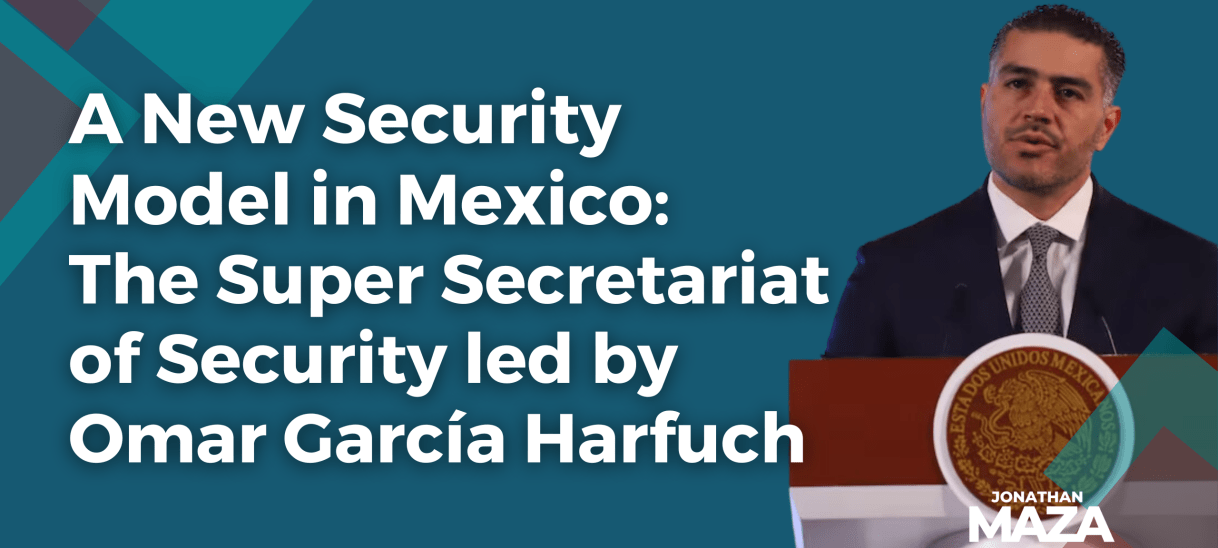
A New Security Model in Mexico: The Super Secretariat of Security led by Omar García Harfuch

ANALYSIS OF THE BILL TO AMEND ARTICLE 21 OF THE MEXICAN CONSTITUTION REGARDING PUBLIC SECURITY.

By Jonathan Maza

The recent reform proposal to Article 21 of the Mexican Constitution[1] outlines a fundamental change in the structure and functions of the Secretariat of Security and Citizen Protection (SSPC), transforming it into an institution with expanded powers not only in public security but also in national security coordination. This reform aims to strengthen crime fighting and reduce criminality by equipping the SSPC with the tools to investigate crimes, coordinate intelligence gathering and analysis in public security, and lead joint operations across various levels of government.

A Significant Change in the Security Model

Omar García Harfuch, accompanying Claudia Sheinbaum, during the presentation of the National Security Strategy.

One of the most notable aspects of the reform is the integration of the SSPC in crime investigation, enabling it to act as a central intelligence and coordination body. With these powers, the SSPC could become a Super-Ministry, as, under the direction of the Federal Prosecutor’s Office, it will be able to conduct investigations and execute arrest warrants, in addition to coordinating all public security institutions nationwide. This centralization of functions could, in theory, increase the effectiveness of security operations by allowing the SSPC to take an active and strategic role in intelligence collection and usage.

However, this change raises questions about its implementation and potential consequences. Centralizing authority within the SSPC could create tensions among the various security agencies in the country, which have historically operated autonomously and with varying levels of coordination. The constitutional reform seeks to address these challenges by establishing the Executive Secretariat of the National Public Security System (SNSP), tasked with standardizing criteria and protocols across all levels of government. Nevertheless, effective standardization and coordination among all security agencies remains a challenge in Mexico, and the success of this reform will depend on the SSPC’s ability to overcome this historical barrier.

Coordination with Military and Naval Intelligence: Advantage or Risk?

Another important feature of the reform is the SSPC’s authority to coordinate the intelligence system in public security and request information from the Attorney General’s Office (FGR), states prosecutors, states and local police forces, as well as intelligence from the National Guard and military forces. This capability could streamline information flow and improve operational effectiveness, giving the SSPC a comprehensive operational capacity and a panoramic view of the country’s security landscape. However, this expanded authority could also create friction with other institutions, particularly those under the control of the Secretariat of National Defense (SEDENA) and the Secretariat of the Navy (SEMAR), as the SSPC will act as a recipient and coordinator of sensitive information originating from military intelligence.

Moreover, as the SSPC will depend on the operational capabilities of SEDENA (through the National Guard) and SEMAR to carry out joint security operations, it must find a balance between effective collaboration and the necessary autonomy to preserve its original mandate. Potential risks include an increasing militarization of public security policies and the blurring of the line between public security and national security, which could face resistance from civilian entities and national and international human rights organizations.

Challenges and Future Prospects

Omar García Harfuch walks the streets of Culiacán (Sinaloa) with the head of the Secretary of National Defense. On October 8, 2024.

The reform also grants the SSPC the authority to «coordinate» and «request information» from states and municipal agencies. This could shift the balance of power in public security between different levels of government, concentrating more control in the federal sphere. While this coordination could enhance cohesive responses to security issues, it also poses a considerable challenge regarding states autonomy and the SSPC’s operational and technological capacity to implement and execute this centralized vision.

In conclusion, this reform to Article 21 is an ambitious attempt to consolidate a more robust and effective security strategy in Mexico. By granting broad powers to the SSPC, the Mexican government seeks to centralize and optimize the fight against crime and violence. However, the effectiveness of this reform will depend on factors such as the SSPC’s ability to manage its new responsibilities without creating interagency conflicts, effective collaboration with the armed forces and the National Guard, and the ability to coordinate seamlessly with all levels of government, where governors play a key role in facilitating or hindering federal efforts. The transformation of the SSPC into a Super-Ministry represents a significant challenge and, at the same time, an opportunity to reconfigure Mexico’s public security strategy.


[1] Constitutional Reform Initiative Submitted by the President of Mexico, Dr. Claudia Sheinbaum Pardo, to the Senate of the Republic on October 30, 2024.


About the author

Jonathan Maza is a specialist in National Security and intelligence in Mexico. He is currently the Director of Strategy and Intelligence at STRATOP Risk Consulting and a Partner at NORA Intelligence. He holds a Master’s degree in National Security from the National Defense College (SEDENA) and a Bachelor’s degree in International Relations with a specialization in International Politics and Diplomacy from the Popular Autonomous University of the State of Puebla. He is also a graduate of the William J. Perry Center for Hemispheric Defense Studies and the U.S. Political Institutions program at the School of Global Policy and Strategy at the University of California, San Diego.

He is a part-time professor in the Department of International Relations and Political Science at the University of the Americas Puebla and an associate member of the Mexican Council on Foreign Relations (COMEXI).

In the public sector, he has served as an advisor in the Mexican Senate on the Public Security and National Defense committees, as a public official in the Government of the State of Puebla, and in the municipality of Puebla de Zaragoza.