
Will He Further Erode the Checks on Executive Power?
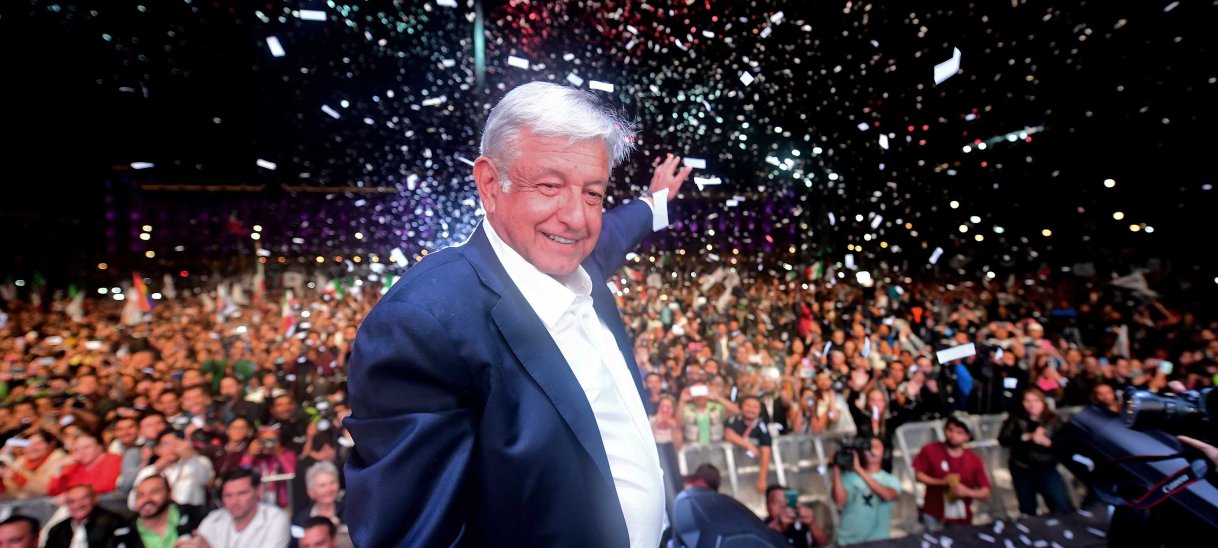
Yesterday, Andrés Manuel López Obrador, best known by his initials, AMLO, won Mexico’s presidential election decisively. After 18 years on the campaign trail, including two previous failed presidential runs, thousands of rallies, and, by his count, a visit to every one of Mexico’s 2,400 municipalities, the Tabasco-born politician received the support of 53 percent of voters at the polls, according to an offical rapid count by electoral authorities. Meanwhile, the National Regeneration Movement (MORENA), López Obrador’s four-year-old political party gained a majority in congress and a majority of the nine governorships up for grabs.
López Obrador’s lambasting of Mexico’s corruption, violence, and deep-seated inequalities resonated broadly with the country’s voters. Yet his victory stemmed in no small part from the shortcomings and outright collapse of his competitors. Second-place finisher Ricardo Anaya ran a disorganized campaign with few graspable policy positions. And five-time cabinet member José Antonio Meade, while seen as personally honest and capable, couldn’t rescue the reputation of the Institutional Revolutionary Party (PRI), undone in the eyes of voters by corruption scandal after corruption scandal.
A big question now is what López Obrador will do. His campaign revealed a multitude of voices and positions, with his surrogates often contradicting both the candidate and themselves. But even more important for Mexico’s future will be how López Obrador chooses to enact his policies—and whether he will abide by the often frustrating institutional checks and balances within Mexico’s democratic political system. Here, Peña Nieto and his administration’s institutional chicanery has opened the space and set precedents for López Obrador to further erode the democratic rules of the game.
THE POLICY AGENDA
López Obrador’s big-tent philosophy, which helped him prevail where he failed in the past, has created conflicting interests and likely rival factions in his governing coalition, raising questions about what his specific policies will be. Progressive MORENA loyalists work awkwardly alongside seasoned PRI political operatives, and Workers’ Party delegates will serve side by side with socially conservative Social Encounter Party members.
López Obrador’s personal record also seems contradictory: although he often appears thin-skinned and autocratic, he can be a pragmatic dealmaker, as evidenced by his collaboration as mayor of Mexico City with multi-billionaire Carlos Slim to restore the capital’s historic downtown. Portrayed as a leftist populist by most media outlets, he is also deeply socially conservative—opposed to gay marriage, same-sex adoption, abortion rights, and the legalization of marijuana. While crusading against corruption, he has defended supporters with tainted records, most recently Senator Layda Sansores, who became mired in scandal for charging makeup, jewelry, her grandchildren’s toys, and a host of other personal expenses to taxpayers. Most important, although promising to give voice to Mexico’s oppressed, to throw out the “mafia of power” that has controlled Mexico for so long, López Obrador doesn’t seem to particularly care for democracy’s norms, routinely criticizing the press, independent civil society organizations, the Supreme Court, and others he perceives to have wronged him.
Most observers are focused on his populist economic plans. There, the question is less what he wants to do than how far he will go and how fast his policies will happen. He is unlikely to upend NAFTA—the bigger threat to the quarter-century-old trade agreement comes from the United States. Instead, supporters and detractors alike expect him to shift Mexico’s domestic economic paradigm, expanding the role of government through a broader social safety net and active industrial policies. This will include a mix of benefits for the old and young—higher pensions for retirees and free schooling and apprenticeships for those just starting out. It will also include a minimum-wage hike for workers.
Meanwhile, an invigorated Mexican industrial policy will start on the farm. López Obrador plans to promote food self-sufficiency through a mix of price floors on basic foods such as corn, beans, rice, and beef, combined with cheap or free fertilizer and other government benefits. He has also spoken about spurring economic development in the depressed southeastern states by planting one million hectares of fruit trees, and providing other supports to expand the economic and political clout of Mexico’s small farmers.
Another state champion under López Obrador will be the energy sector. Although talk by his critics of his tearing up private contracts is overblown, the state-owned petroleum company Pemex will likely reclaim its dominant role, the government slowing if not stopping the fast-paced auctions of the last three years, which opened up exploration and production in Mexico to private companies for the first time in over 70 years. And to fulfill the mantra of energy self-sufficiency, billions may go to new refineries. More broadly, López Obrador has promised nearly to double public infrastructure investment as a percentage of GDP, talking of new highways, airports, passenger trains, and an overland Pacific to Atlantic transportation corridor to rival the Panama Canal.
It is unclear how much of this expansive economic agenda will become actual policy. These programs will all cost large sums of money, and López Obrador also promised not to raise taxes or the debt on the campaign trail. Even rising oil prices won’t feed the public treasury as much as in the past; domestic oil production is in decline, and the nation is now a net importer.
Beyond the economy, it is unclear if and how López Obrador will translate his promises into actions.
Beyond the economy, it is unclear if and how López Obrador will translate his promises into actions. Although taking on Mexico’s deep-seated corruption and reducing historic levels of violence were part of almost every campaign stump speech, he hasn’t let on how he plans to get results. (Morevoer, López Obrador enters office with fraught relations with Mexico’s military, the main stabilizing security force on the streets and in Mexico’s hills today.) Rather, he has been clearest on what policies he will end. He has promised to roll back an education reform designed to limit union control over public schools and transform the curriculum and way of teaching Mexico’s youth, despite its general popularity. And in the international sphere, he and his foreign minister designate have made clear their lack of interest in continuing to play a regional leadership role, particularly on Venezuela.
THE RETURN OF AN UNCHECKED EXECUTIVE?
Just as important as what López Obrador’s policies will be is how he will go about implementing them. Mexico was long known for its imperial presidency, the head of government constrained largely only by a one-term limit. The office’s power dispersed somewhat with democratization and the rise of divided government. But during the Peña Nieto administration, power again concentrated in the executive.

The last bastion of democratic defense comes from civil society and a free press. Here, too, Peña Nieto has abused the president’s power. The government stands accused of using sophisticated Israeli spy software not to go after drug cartels but to dig up dirt on journalists and civil society leaders. It has also harassed its critics through repeated tax audits and has utilized its immense public advertising budget to reward media outlets proffering favorable headlines.
López Obrador has already painted independent think tanks and nongovernmental organizations with an ugly brush, dismissing them as abetting the “mafia of power” he has come to defeat. He has also publicly opposed any active governmental oversight role for civil society, for instance in choosing an independent prosecutor. The next president has gotten into his fair share of dustups with the press—emulating the attacks more often heard to Mexico’s north about “fake news” when media reports go against him. In the weeks before the election he went after Reforma, one of the most independent-minded of Mexico’s media outlets, and has repeatedly called out prominent columnists for criticizing his platforms, suggesting more scuffles to come once in office. Perhaps in anticipation of his win, in April his MORENA party voted alongside the PRI in the lower house to keep the Ley Chayote, the slang term Mexicans use to talk about the long-held government practice of doling out payments to journalists and news outlets to gain favorable coverage.
Whether López Obrador turns out to be an economic pragmatist or a populist will shape Mexico’s financial trajectory. But more important for the nation’s political future will be whether he chooses to recognize and respect institutional checks and balances. If he does not, he will ultimately be to blame for undermining Mexico’s still-fragile democracy. But so too will Peña Nieto and his administration, as their choices and behavior over the last six years will have opened the door to further abuse of the system.
Publicado el 2 de julio en: https://www.foreignaffairs.com/articles/mexico/2018-07-02/lopez-obrador-and-future-mexican-democracy

 Jonathan Maza