
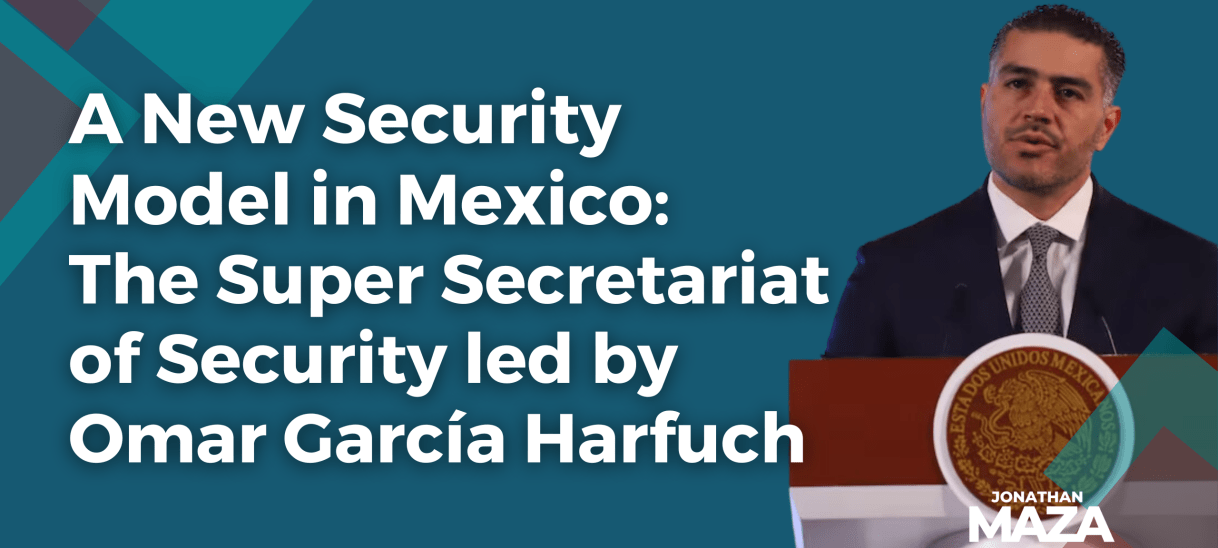
ANALYSIS OF THE BILL TO AMEND ARTICLE 21 OF THE MEXICAN CONSTITUTION REGARDING PUBLIC SECURITY.
The recent reform proposal to Article 21 of the Mexican Constitution[1] outlines a fundamental change in the structure and functions of the Secretariat of Security and Citizen Protection (SSPC), transforming it into an institution with expanded powers not only in public security but also in national security coordination. This reform aims to strengthen crime fighting and reduce criminality by equipping the SSPC with the tools to investigate crimes, coordinate intelligence gathering and analysis in public security, and lead joint operations across various levels of government.
A Significant Change in the Security Model

One of the most notable aspects of the reform is the integration of the SSPC in crime investigation, enabling it to act as a central intelligence and coordination body. With these powers, the SSPC could become a Super-Ministry, as, under the direction of the Federal Prosecutor’s Office, it will be able to conduct investigations and execute arrest warrants, in addition to coordinating all public security institutions nationwide. This centralization of functions could, in theory, increase the effectiveness of security operations by allowing the SSPC to take an active and strategic role in intelligence collection and usage.
However, this change raises questions about its implementation and potential consequences. Centralizing authority within the SSPC could create tensions among the various security agencies in the country, which have historically operated autonomously and with varying levels of coordination. The constitutional reform seeks to address these challenges by establishing the Executive Secretariat of the National Public Security System (SNSP), tasked with standardizing criteria and protocols across all levels of government. Nevertheless, effective standardization and coordination among all security agencies remains a challenge in Mexico, and the success of this reform will depend on the SSPC’s ability to overcome this historical barrier.
Coordination with Military and Naval Intelligence: Advantage or Risk?
Another important feature of the reform is the SSPC’s authority to coordinate the intelligence system in public security and request information from the Attorney General’s Office (FGR), states prosecutors, states and local police forces, as well as intelligence from the National Guard and military forces. This capability could streamline information flow and improve operational effectiveness, giving the SSPC a comprehensive operational capacity and a panoramic view of the country’s security landscape. However, this expanded authority could also create friction with other institutions, particularly those under the control of the Secretariat of National Defense (SEDENA) and the Secretariat of the Navy (SEMAR), as the SSPC will act as a recipient and coordinator of sensitive information originating from military intelligence.
Moreover, as the SSPC will depend on the operational capabilities of SEDENA (through the National Guard) and SEMAR to carry out joint security operations, it must find a balance between effective collaboration and the necessary autonomy to preserve its original mandate. Potential risks include an increasing militarization of public security policies and the blurring of the line between public security and national security, which could face resistance from civilian entities and national and international human rights organizations.
Challenges and Future Prospects

The reform also grants the SSPC the authority to «coordinate» and «request information» from states and municipal agencies. This could shift the balance of power in public security between different levels of government, concentrating more control in the federal sphere. While this coordination could enhance cohesive responses to security issues, it also poses a considerable challenge regarding states autonomy and the SSPC’s operational and technological capacity to implement and execute this centralized vision.
In conclusion, this reform to Article 21 is an ambitious attempt to consolidate a more robust and effective security strategy in Mexico. By granting broad powers to the SSPC, the Mexican government seeks to centralize and optimize the fight against crime and violence. However, the effectiveness of this reform will depend on factors such as the SSPC’s ability to manage its new responsibilities without creating interagency conflicts, effective collaboration with the armed forces and the National Guard, and the ability to coordinate seamlessly with all levels of government, where governors play a key role in facilitating or hindering federal efforts. The transformation of the SSPC into a Super-Ministry represents a significant challenge and, at the same time, an opportunity to reconfigure Mexico’s public security strategy.
[1] Constitutional Reform Initiative Submitted by the President of Mexico, Dr. Claudia Sheinbaum Pardo, to the Senate of the Republic on October 30, 2024.
About the author
Jonathan Maza is a specialist in National Security and intelligence in Mexico. He is currently the Director of Strategy and Intelligence at STRATOP Risk Consulting and a Partner at NORA Intelligence. He holds a Master’s degree in National Security from the National Defense College (SEDENA) and a Bachelor’s degree in International Relations with a specialization in International Politics and Diplomacy from the Popular Autonomous University of the State of Puebla. He is also a graduate of the William J. Perry Center for Hemispheric Defense Studies and the U.S. Political Institutions program at the School of Global Policy and Strategy at the University of California, San Diego.
He is a part-time professor in the Department of International Relations and Political Science at the University of the Americas Puebla and an associate member of the Mexican Council on Foreign Relations (COMEXI).
In the public sector, he has served as an advisor in the Mexican Senate on the Public Security and National Defense committees, as a public official in the Government of the State of Puebla, and in the municipality of Puebla de Zaragoza.
 Jonathan Maza